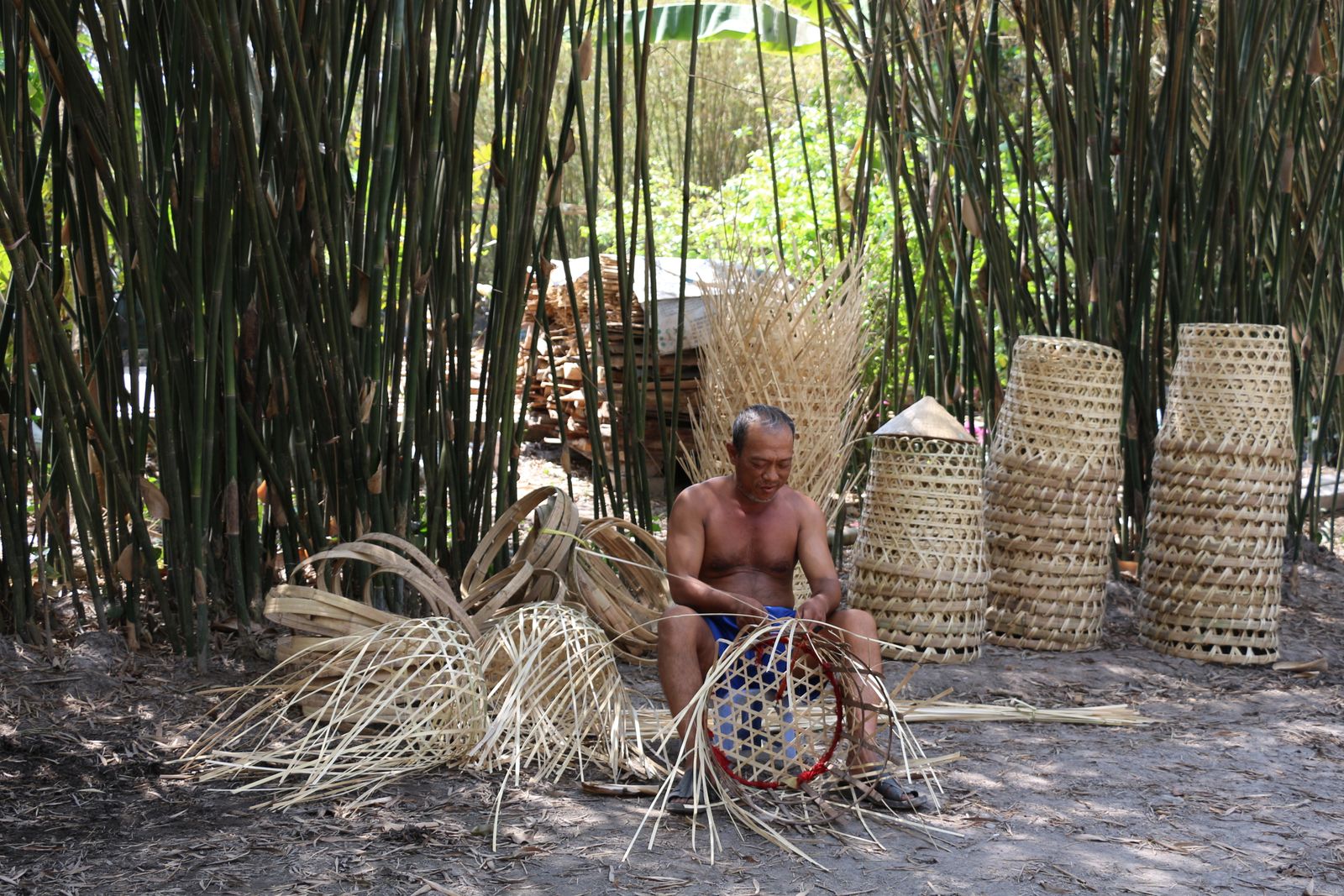
At 6:40 on a January morning, the grove is quieter than a room. Frost sits on the top leaves. The culms knock together in the wind with a sound like distant wood blocks. Su Chengjun walks the path along the riverbank with a short red thread in his hand, stopping every few metres to look up.
He is not counting bamboo. He is choosing it. A culm must be three years old — not two, not four. It must be straight, with nodes evenly spaced and no scar from a falling branch. It must stand where the morning light reaches it, because a culm that has spent its life in shadow holds too much moisture. Of the hundreds in this grove, he will mark perhaps twenty.
The red thread is tied at eye level. By afternoon, the selected culms will be cut. This is the first of fifteen processes, and it is the one that cannot be corrected later.
01 The grove in January
Winter is not a romantic choice. It is a technical one. In the growing season, bamboo pulls water and sugar upward through its walls; the fibre is soft, the starch high, the colour green. In deep winter, the sap withdraws into the rhizome and the culm becomes something closer to wood: dense, dry, and unusually resistant to insects.
“A summer culm will look beautiful for a year,” Su says. “Then the beetle finds it. A winter culm is quieter from the beginning, and it stays quiet.” He taps a marked stem with his knuckle. The sound is high and closed, like a ceramic cup.
There is a second reason for the season. Cutting in winter leaves the spring shoots untouched. The grove is not a mine; it is a household that must be left in better condition than you found it. Su's father taught him to take no more than one stem in five, and to leave the oldest and the youngest standing.
“The best time to cut bamboo is when the bamboo is asleep. That is when it tells you the truth about itself.”Su Chengjun · third-generation weaver
The marked culms are felled just above a node, trimmed in the field, and carried out on foot. No vehicle enters the grove. By dusk, the stems are stacked under the workshop eaves, their cut ends facing the wall, waiting for the split.
02 Why this bamboo, why this place
Not every bamboo can become a Longshu mat. The species used here is Xiaoye shuizhu — small-leaf water bamboo — which grows on the shaded banks and damp terraces around Linshui Zhai. Its walls are thinner than moso, its grain longer, its fibre more elastic. It splits into strips that bend almost to the point of folding without cracking.
The place matters as much as the plant. The village sits in the old Huai River country, where the water table is high and the air moves slowly. Culms grown here are less prone to the brittle, chalky centre that ruins a strip halfway through a mat. Local weavers can tell the difference with a thumbnail: a good strip yields slightly, then springs back.
That spring is the whole craft in miniature. A mat is not a flat object; it is a lattice under tension. Every strip pulls against its neighbours. If one is too dry, the surface cups. If one is too green, it shrinks and opens a gap. The fifteen processes exist to bring every strip to the same quiet equilibrium.
From the story · Entry edition
The First Weave Kit
Pre-cut Xiaoye water bamboo, natural dyes and a fifteen-step guide. Begin with a two-hour mat.
View the kit03 Fifteen hands, one strip
The traditional count is fifteen: select, fell, trim, cut to length, split, peel, delaminate, boil, shade-dry, scrape, calibrate, dye, weave, bind and burnish. The names are plain. The work is not.
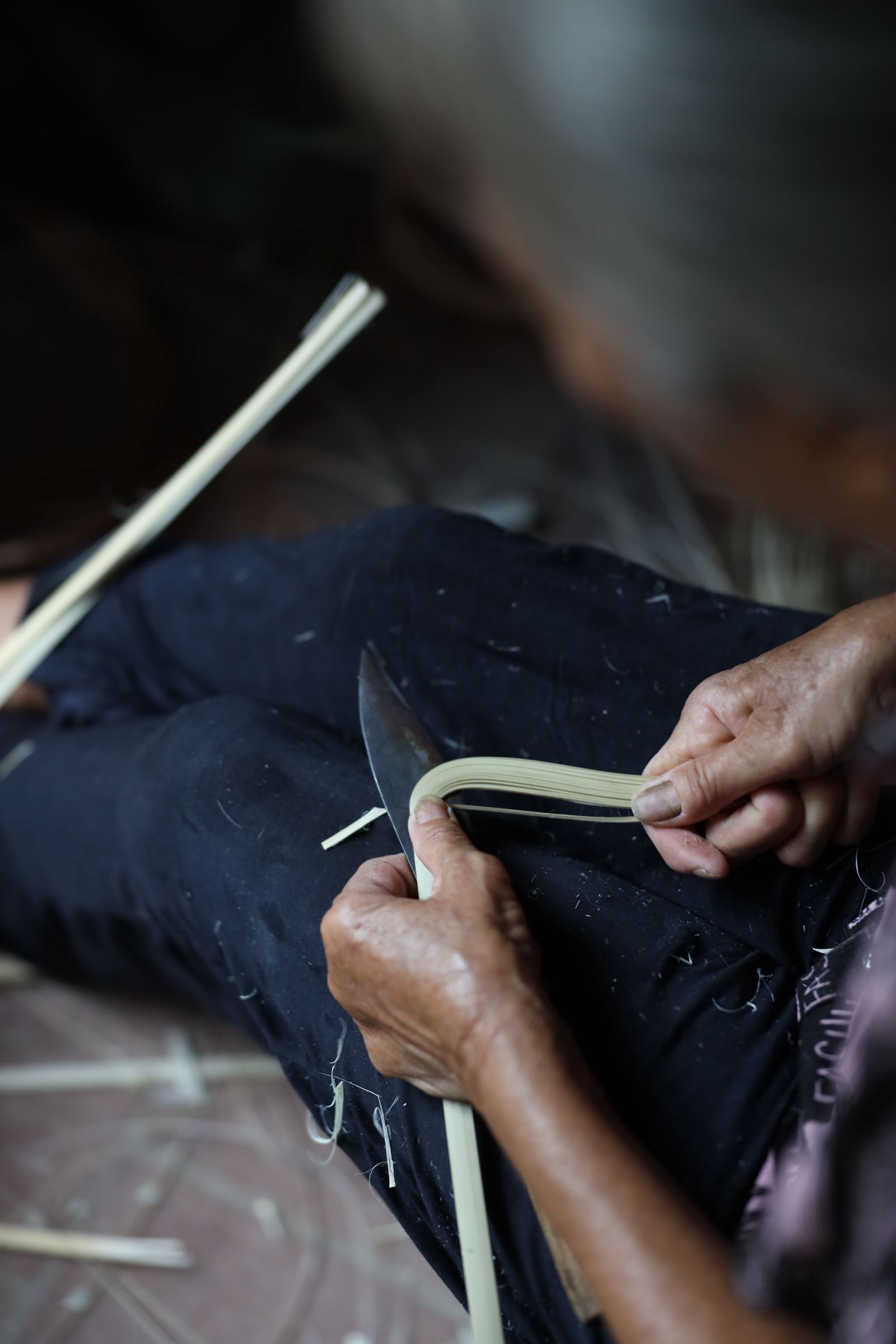
Splitting is the threshold. A steel blade is tapped into the end of the culm and the whole length opens along its grain — a sound like a zipper, followed by a smell of green sap and dust. The resulting strips are then peeled apart, layer by layer. A single wall of bamboo can yield eight usable strips, each one thinner than the last.
Calibration is done by eye and thumb. There is no gauge. The target is around 0.2mm — thin enough to flex between the fingers, thick enough to hold a edge. “If you need to measure it,” Su says, “you have already lost the feel.” He tests each strip against the ball of his thumb, then against his lower lip, where the skin is more sensitive.
The strips are boiled, shaded, scraped and laid out in bundles according to tone. Then the weaving begins. A mat of one metre by two takes five to twelve days, depending on the pattern. The weaver works from memory, lifting and tucking thousands of strips into a continuous plane. There is no drawing on paper. The pattern lives in the hands.
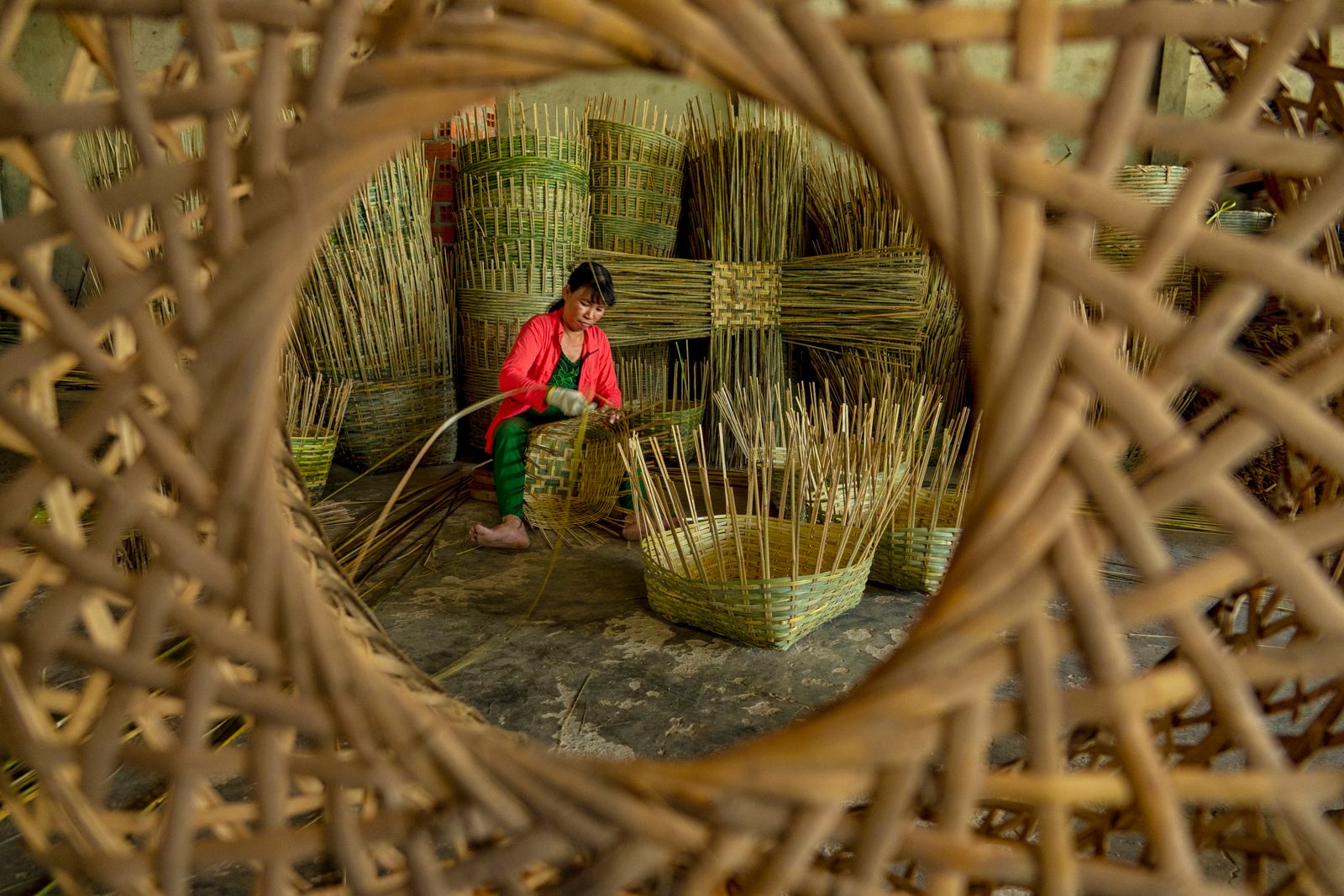
When the surface is complete, the edges are folded and bound with a heavier strip, then stitched with linen thread. The mat is burnished with beeswax and a smooth stone, and left to rest. Only then is it signed.
04 Ink in the weave
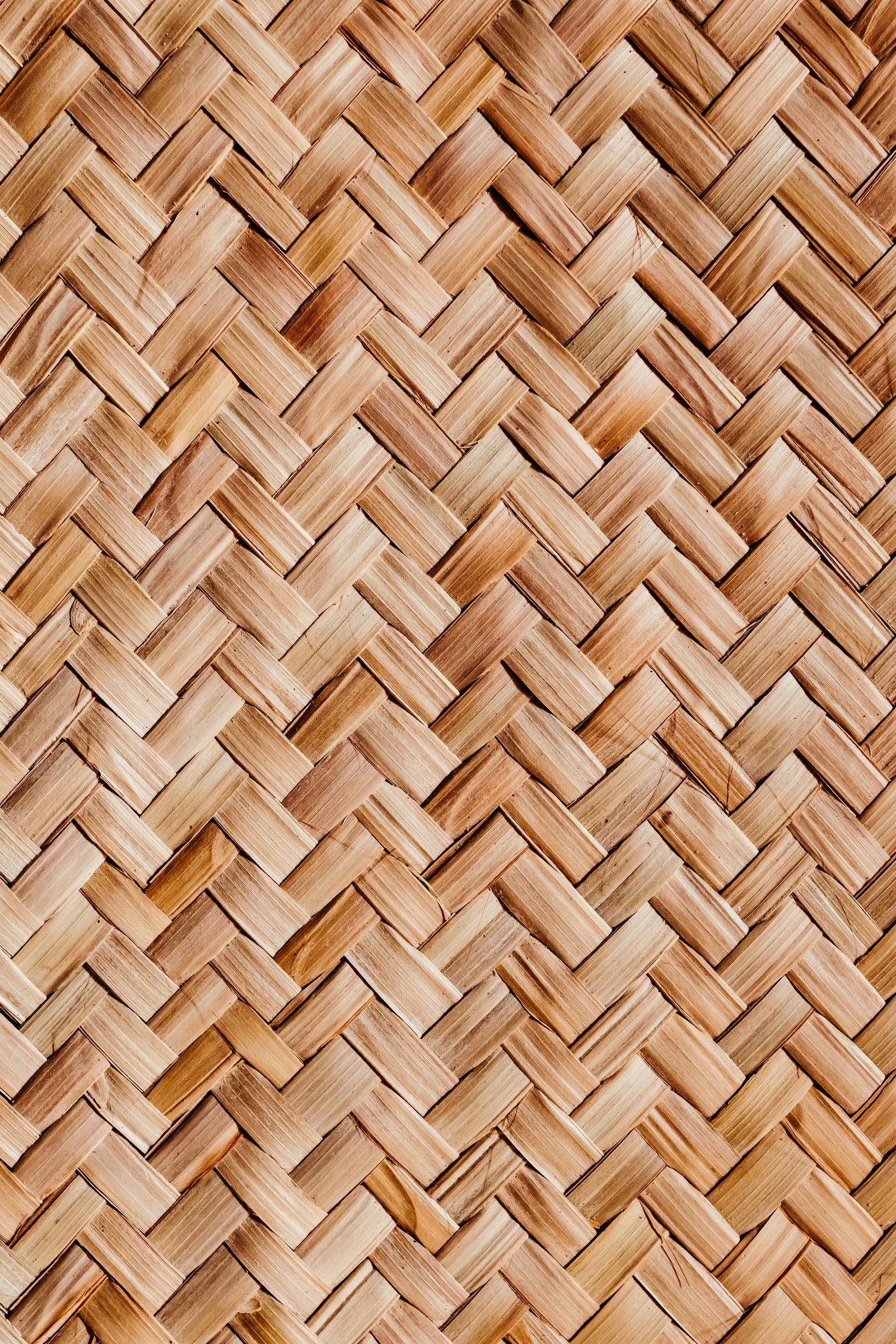
The colour of a Longshu mat is not applied like paint. It is drawn into the fibre before weaving, using plant dyes and slow smoke. The palette is narrow on purpose: moss, pine, deep forest, ink, and the raw pale gold of undyed bamboo. The aim is not decoration but atmosphere — the soft, unfixed tonality of a wet ink wash.
Because the dye penetrates unevenly, no two strips take the colour in exactly the same way. The weaver sorts them by tone and places them so that the variation reads as depth rather than accident. In a finished mat, the surface seems to hold a faint mist. Move it into different light and the mist moves too.
This is the quality that separates a heritage mat from a printed one. A print is stable and flat. A woven tonal surface is alive. It records the season, the strip and the hand — and it continues to change as the bamboo oxidises, deepening slowly over years.
From the story · Heritage edition
The Longshu Masterwork
Numbered 1 of 50, signed by Su Chengjun, with a harvest record and maker's certificate.
See the edition05 A craft that lives in the room
The mat was never a museum object. It was a surface for living: spread on a kang in winter, laid over a wooden bench in summer, used to dry tea leaves or cool a bowl of fruit. Its virtue was usefulness, and usefulness is what keeps a craft alive.
In a contemporary room, that usefulness has not changed. A mat softens a hard table. It gives a tea set a stage. It introduces a quiet, tactile layer between the body and the architecture — something between furniture and textile. In the wabi-sabi vocabulary, it is an object that improves by being used: the edges darken, the surface polishes, the colour settles.
“People think heritage means old,” Su says. “I think it means still here. A mat on a table in Shanghai is as much a part of this craft as a mat in a tomb two thousand years ago.”
06 How to care for a mat
A well-kept mat will outlast the room it was bought for. The rules are simple, and mostly about restraint.
- 01Keep it out of direct sun. Bamboo darkens unevenly under UV; indirect light is enough.
- 02Wipe with a barely damp cloth, then dry immediately. Never soak or scrub the weave.
- 03Air it in shade once a season, away from damp walls and radiators.
- 04Roll, do not fold, for storage. A fold pressed into bamboo becomes a permanent memory.
- 05Use it. The surface is meant to be touched; handling is part of the finish.
The first cut is an act of restraint: choose one stem in five, cut when the plant is asleep, take only what the grove can spare. Everything that follows — the fifteen processes, the ink, the signature — is an extension of that first decision. A mat is not made in a workshop. It begins in the grove, in winter, with a hand that knows what to leave standing.
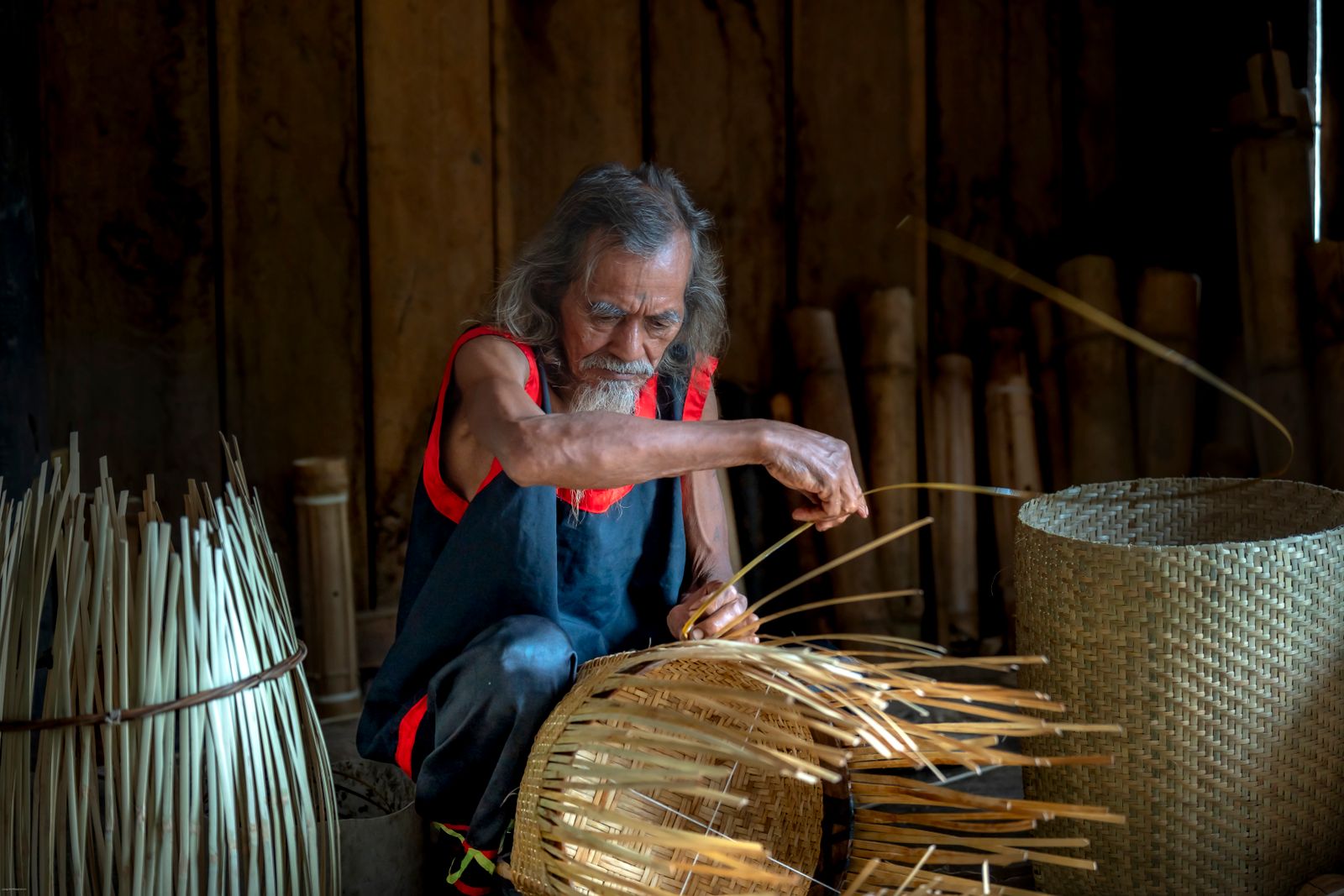
Su Chengjun
Su Chengjun has worked at the Longshu loom for more than four decades. He was named a representative inheritor of the national intangible cultural heritage in 2008 and signs every Heritage edition.